
Brake Dynamometer with Electric Inertia Simulation
Brake System Testing
Information and quotation request
Just mention the product code in your request. Sharing specimen details and the test specification speeds things up.
About the system
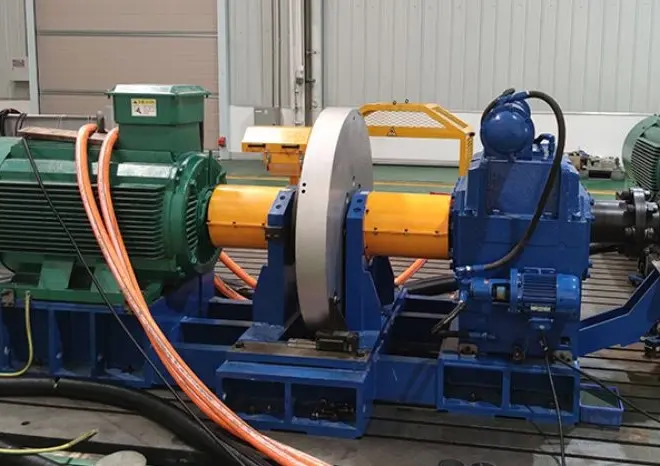
The brake dynamometer with electric inertia simulation replaces mechanical flywheels with motor control to simulate vehicle mass and tests brake discs, pads, drums and complete brake systems under real driving conditions. Besides passenger-car and commercial-vehicle versions it is configured for rail, mining, aviation and industrial brakes. Inertia from 1 to 8000 kg·m² is set with ±1% accuracy, and complete pedal-to-wheel braking systems can also be tested.
Technical scope
- Passenger & commercial: 15–2500 rpm
- Inertia 1–8000 kg·m² (electric simulation, ±1%)
- Torque up to 40 000 Nm
- 0–1000 °C
- Pedal-to-wheel braking system
- Rail/mining/aviation/industrial
Test functions and capabilities
- Burnish, efficiency, fade and recovery
- Friction and wear, parking brake, drag torque
- Constant pressure / constant torque / constant deceleration modes
- Disc thickness variation (DTV), water spray and dust tests
- Pedal-to-wheel braking system: efficiency, fade, wear, noise, ABS, brake force distribution, response
- Torsional fatigue and static torque options
Configurations and technical data
| Configuration | Technical values |
|---|---|
| Passenger car | 25–2000 rpm; inertia 1–250 kg·m²; 1–16 MPa; 0–5000 Nm |
| Commercial vehicle | 15–1200 rpm; inertia 300–3000 kg·m²; 0–1.6 MPa air; 0–40 000 Nm |
| High-inertia version | Electric inertia 5–8000 kg·m², ±1%; 1200–1500 rpm |
| Heavy-duty version | 390 kW; 300–25 000 Nm; 1000 rpm; 0–16 MPa |
| Rail | 0–20 000 Nm |
| Aviation | 0–100 000 Nm; 28 MPa |
| Temperature & cooling | 0–1000 °C; cooling air 0–15 m/s, 5000 m³/h |
| Inertia accuracy | ±1% or better |
Values show the range of available configurations. Final technical values are defined by the project specification.
Project scope
- Joint definition of the technical specification
- Configuration and layout proposal
- Installation, commissioning and acceptance tests
- Operator training and after-sales technical support
Other systems in this group
Air Brake Valve Test Bench
0–1.6 MPa · Drive force up to 50 kN
Air Brake Valve Durability Bench
1–3 stations · 0–1.6 MPa
Slack Adjuster Test Bench
Torque 0–3600 Nm · Force 0–35 kN
Brake Fatigue & Torsional Strength Bench
Torque up to 60 000 Nm · Air 0–1.4 MPa / hydraulic 0–35 MPa
Hydraulic Brake Component & Vacuum Test Bench
Vacuum booster & master cylinder · 0–25 MPa
Caliper & Wheel Cylinder Test Benches
Hydraulic & air calipers, wheel cylinders · Up to 60 MPa