
Shock Absorber Test Bench
Servo-Hydraulic & Road Simulation
Information and quotation request
Just mention the product code in your request. Sharing specimen details and the test specification speeds things up.
About the system
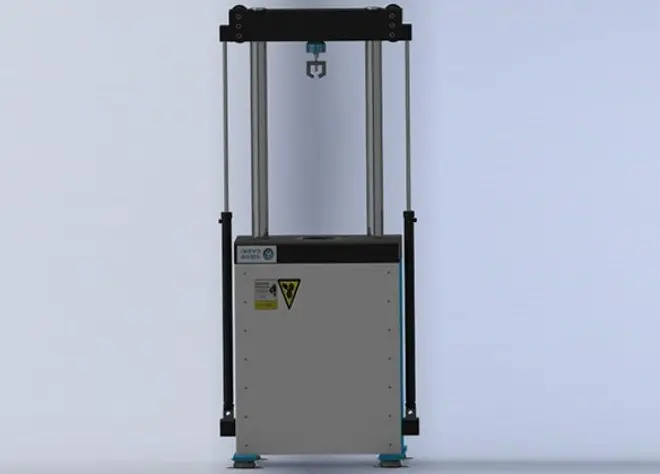
The shock absorber test bench measures force-velocity and force-displacement characteristics, temperature dependence and noise of dampers. Versions include hydraulic drive, servo-motor linear drive producing true sinusoidal motion without crank linkage, and high-speed versions up to 4 m/s. Options include vertical and horizontal (0–90° tilt) mounting, a −50…180 °C climatic chamber, noise testing and a mobile test vehicle for on-site or proving-ground tuning.
Technical scope
- 25–50 kN; up to 4 m/s
- Hydraulic or servo-motor linear drive
- Vertical & horizontal (0–90°)
- Climatic chamber −50…180 °C; noise testing
- Mobile test-vehicle version
Test functions and capabilities
- Force-velocity and force-displacement curves
- Sine, triangle, square, sweep and road-profile waveforms
- Hot/cold performance (−50…180 °C)
- Damper noise test (0.01–20 Hz)
- Vertical/horizontal two-way testing, automatic clamping
- On-site tuning with mobile test vehicle
Configurations and technical data
| Configuration | Technical values |
|---|---|
| Performance bench | 2.5 t / 5 t; up to 4 m/s; control ≤0.5%; force resolution 0.1 N |
| High/low temperature | Dynamic 25 kN; 2 m/s; ±50 mm; chamber −50…180 °C |
| Hydraulic drive | 25 kN; 2 m/s; stroke 100 mm; dual-motion; hydraulic beam locking |
| Servo-motor linear drive | 50 kN; 2 mm/s – 1.57 m/s; stroke 100 mm; true sine without crank linkage; low energy and noise |
| Noise bench | 25 kN; 0.01–20 Hz; stroke 0–100 mm |
| Mobile test vehicle | Dynamic 15 kN; 1.57 m/s; ±50 mm; electric |
| Two-way vertical/horizontal | ±50 kN; 2 m/s; ±75 mm; specimen 1000 mm; tilt 0–90° |
Values show the range of available configurations. Final technical values are defined by the project specification.
Project scope
- Joint definition of the technical specification
- Configuration and layout proposal
- Installation, commissioning and acceptance tests
- Operator training and after-sales technical support
Other systems in this group
Tire-Coupled Road Simulator (4/6-Post)
Vehicles 2.5–30 t · ±38–200 kN actuators
Spindle-Coupled Road Simulator
6-DOF per spindle · 6–24 channels
Multi-Channel Cab & Component Vibration System
7 channels · ±125 mm
Servo-Hydraulic Torsional Fatigue Bench
5–50 kNm; heavy-duty up to ±500 kNm · Up to 20 Hz
Flexible Servo-Hydraulic Test Platform
1–9 axes; up to 10 t · Up to 8-channel coordinated loading
Servo-Hydraulic Linear Actuators
15–1000 kN · Stroke up to 400 mm; long-stroke variants